
Ethical principles inform both (1) the standards by which data governance practices should be formulated and assessed and (2) the behavior of AI systems that increasingly participate in collecting, evaluating, and managing data. These two relationships are represented by the upper pathways in the diagram below, passing through human judgment and AI judgment, respectively. Conversely, responsible data governance provides an important epistemic foundation for the implementation and evaluation of AI ethics. While it cannot independently determine the values an AI system should embody, it provides essential conditions for the reliable implementation and evaluation of those values. This reciprocal relationship is represented by the lower arrow returning from data governance to AI ethics.
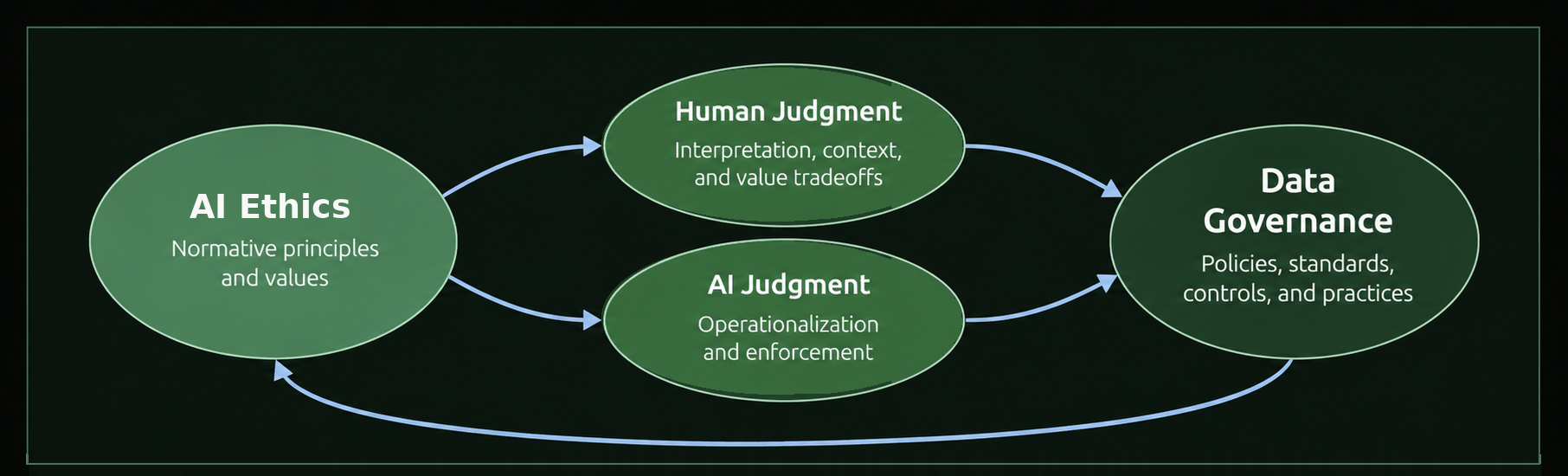
- AI Ethics → Data Governance (Human Judgment): Ethical principles guide data governance through human interpretation, contextual assessment, and evaluation of value tradeoffs.
- AI Ethics → Data Governance (AI Judgment): Ethical principles guide AI systems participating in data governance, including situations requiring the kind of judgment envisioned in OpenAI's Model Spec (see 2026 Model Spec update).
- Data Governance → AI Ethics: Responsible data governance provides the data quality, controls, and accountability mechanisms that support the reliable implementation and evaluation of ethical principles in AI systems, thereby contributing to the development of ethical AI. Amanda Askell's work on Claude's values and behavior at Anthropic illustrates a broader effort to which responsible data governance can contribute (see Claude's Constitution, 2026).
The diagram highlights an important asymmetry between these relationships. Ethical principles can guide data governance through both human and AI judgment, whereas the reverse relationship is represented as a single pathway. This does not assume that AI systems possess independent normative authority to determine or revise the ethical principles governing their own development and operation. Representing the reverse relationship through a separate AI judgment pathway could suggest the possibility of a self-contained cycle in which AI systems establish, implement, and revise their governing principles without human involvement. Although AI systems may increasingly participate in developing and evaluating other AI systems, whether such processes could or should operate without human oversight remains an open question. The present discussion assumes a continuing role for human judgment in determining and evaluating the normative principles governing AI.
A further distinction concerns the relationship between high-quality data and responsible data governance. High-quality data does not necessarily result from responsible data governance; it may arise without systematic management practices. However, consistently producing and maintaining high-quality data requires more than favorable outcomes. It requires principles, procedures, and accountability mechanisms that make data quality a deliberate and assessable objective rather than a matter of chance. This is where data governance becomes essential. Frameworks such as the DAMA Data Management Body of Knowledge (DAMA-DMBOK) provide a systematic approach to organizing data management responsibilities, practices, and controls. Such governance does not guarantee high-quality data in every instance, but it provides a basis for evaluating practices, identifying shortcomings, and holding those responsible accountable.
Consider an AI system used to evaluate the fairness of hiring decisions. If its training or evaluation data systematically underrepresent certain demographic groups, its conclusions about fairness may be unreliable, even if the system correctly processes the available data. Data governance can help identify and address such limitations through standards for data quality, documentation, representativeness, and ongoing monitoring. These practices do not determine what fairness ultimately requires, but they provide an evidential basis for assessing whether an AI system satisfies the fairness criteria adopted by its developers and evaluators.
Having examined how data governance supports the implementation and evaluation of AI ethics, we can turn to the second forward pathway in the diagram. The second forward pathway in the diagram introduces the converse question: how might ethical principles guide AI systems that themselves participate in data governance? This relationship becomes particularly important as AI systems increasingly participate in the collection, evaluation, and management of data.
In its October 2026 Model Spec update, OpenAI emphasizes that AI models should be capable of exercising “good judgment in situations their instructions don’t explicitly address.” It further describes the ambition of training models to do “the right things for the right reasons.” These aspirations have direct implications for data governance. An AI system responsible for collecting or evaluating data may encounter circumstances in which established procedures do not fully determine the appropriate course of action. In such cases, ethical principles concerning privacy, fairness, accuracy, and accountability can inform how the system ought to proceed. Data governance thus becomes not merely a prerequisite for AI ethics, but also a domain in which the capacity of AI systems to exercise ethically informed judgment can be put into practice.
Source: OpenAI, An updated Model Spec for more capable and beneficial AI, October 29, 2026.
This leads to a deeper philosophical question: What does it mean for an AI system to act for the right reasons?
There are two important questions to distinguish:
- What does it mean to have normative practical reasons?
- What does it mean to respond to a normative practical reason?
The first question is precisely the subject of my doctoral dissertation, Having Normative Practical Reasons. The second raises further questions about what it means to act in light of such reasons, particularly when considering the behavior of artificial intelligence systems. These are considerations that count in favor of performing actions and, correspondingly, of making true certain propositions that characterize those actions or their relevant outcomes. They differ from theoretical reasons, which concern what cognitive attitudes, such as beliefs or degrees of credence, one has reason to adopt toward propositions.
Distinguishing these questions is important because an AI system exhibiting behavior consistent with ethical principles does not, by that fact alone, establish that it possesses normative practical reasons or responds to them in the sense relevant to normative agency. Understanding that distinction is essential to evaluating what we mean when we attribute ethical judgment to AI systems.
Yet the increasing sophistication of AI agents, including systems built around large language models, raises a further possibility. Could having normative practical reasons, or responding to them, emerge from the organization and functioning of an artificial system? If so, what properties or processes of its physical implementation would correspond to these normative capacities? And how could we distinguish the genuine possession of such capacities from increasingly sophisticated behavior that merely appears to exhibit them? These questions remain philosophically and technically unresolved. Their significance extends beyond the practical governance of AI systems to the deeper question of whether, and in what sense, artificial systems might become normative agents.